2015–2020
Crowd-Sourced Intelligence Agency (CSIA)
Participatory Surveillance
The Crowd-Sourced Intelligence Agency (CSIA) was functioning replication of an Open-Source Intelligence (OSINT) surveillance system, which included an interface with multiple machine-learning classifiers for predictive policing that allowed the viewer to experience how intelligence analysts view social media posts. The CSIA was created by reverse engineering OSINT dataveillance systems that were currently in use. This included analyzing technical manuals, research reports, academic papers, leaked documents, and Freedom of Information Act files.
- Collaborators Jennifer Gradecki
- Commission Science Gallery Dublin, Trinity College, Dublin, Ireland (2015)
The Crowd-Sourced Intelligence Agency (CSIA) is a functional prototype of an open-source intelligence (OSINT) system assembled from publicly available and declassified law-enforcement training materials. It invites the public to take on the role of an intelligence analyst and confront the ambiguity of automated threat classification firsthand.
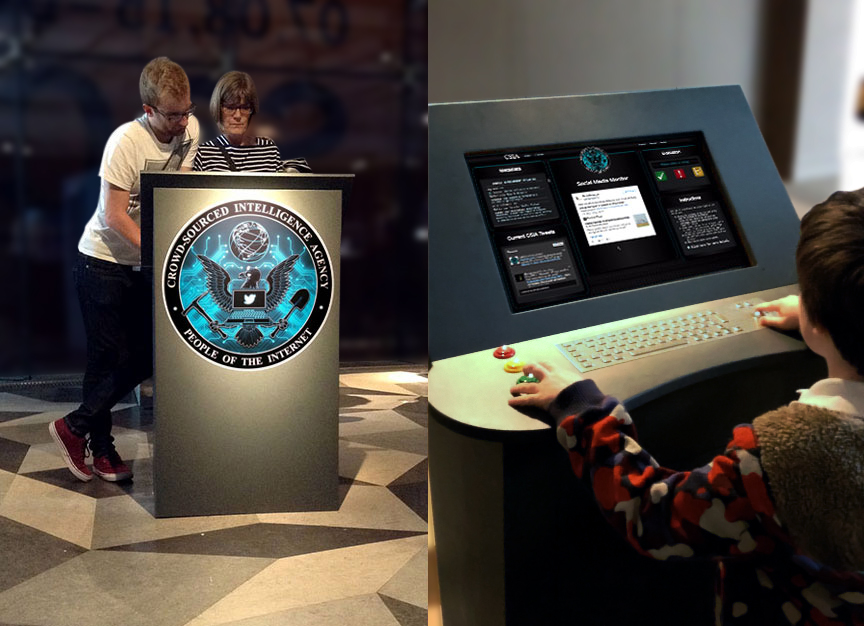
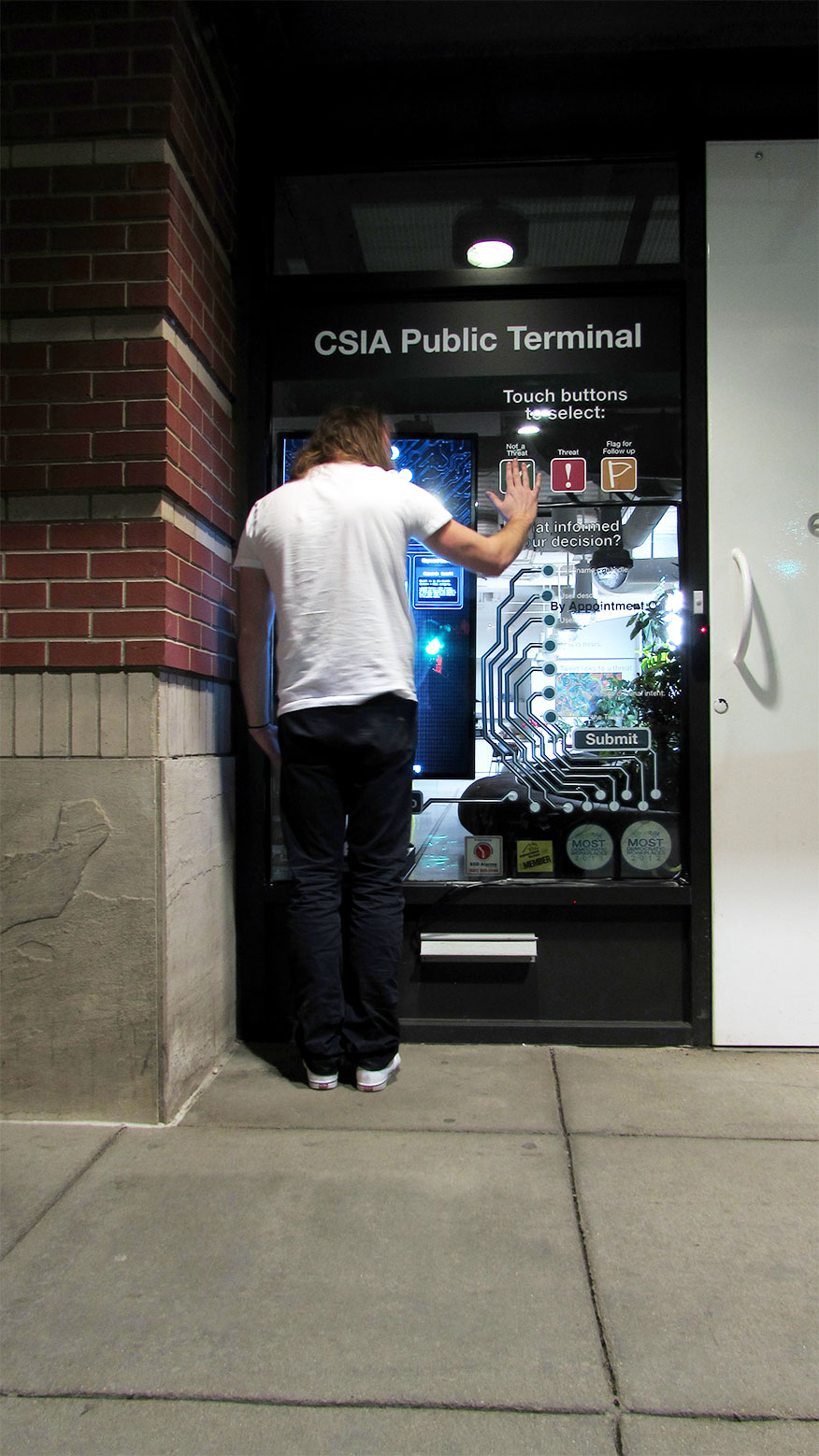
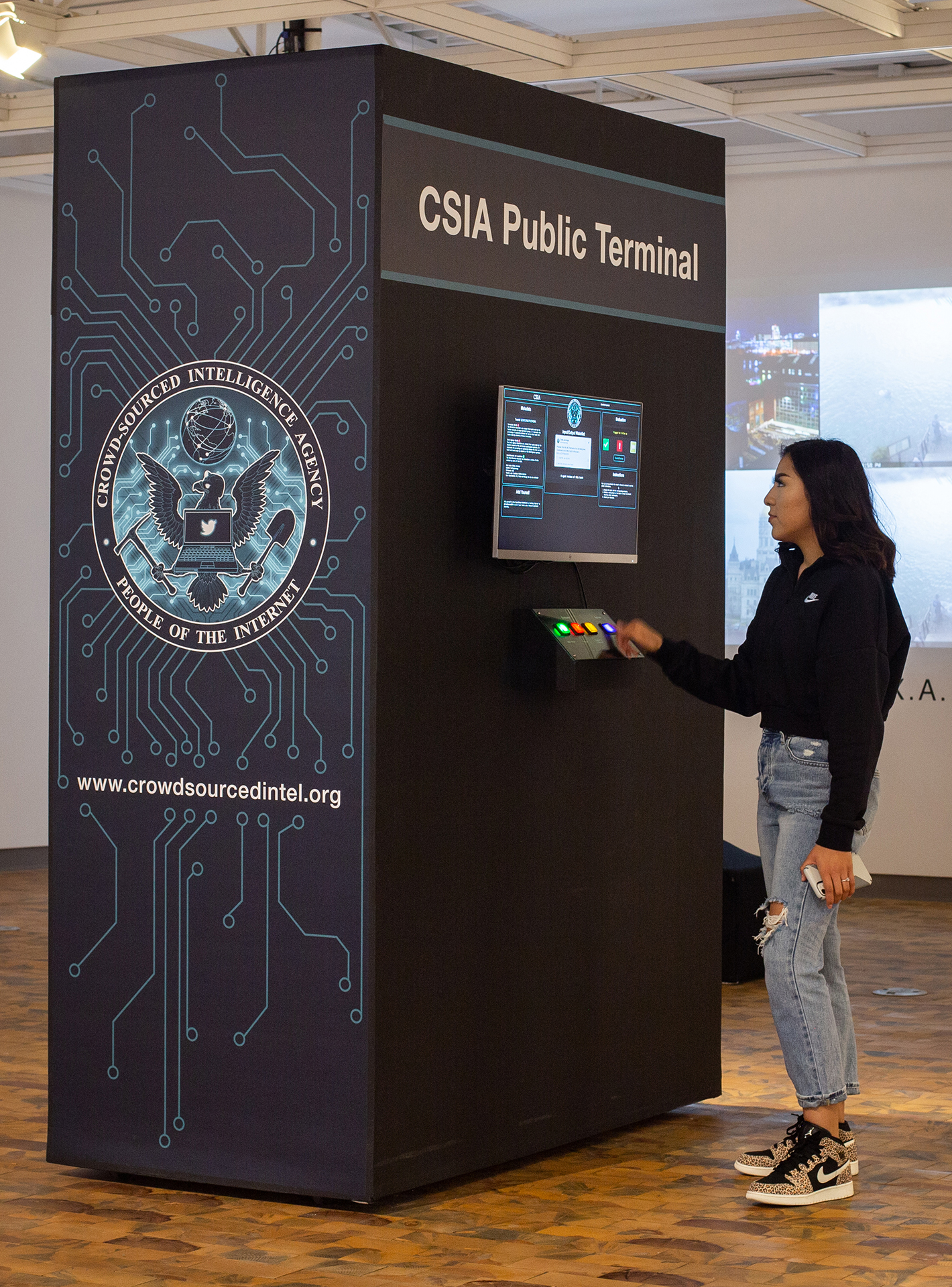
The program consisted of three main parts: a surveillance interface where users can evaluate Tweets based on their threat to national security, a feature that allowed users to test and search their own social media posts, and a Naïve Bayes supervised machine-learning classifier. Users could review the algorithm’s decisions for accuracy and idiosyncrasies. The CSIA provided first-hand experience with social media monitoring, allowing users to choose how they want to navigate social media surveillance.

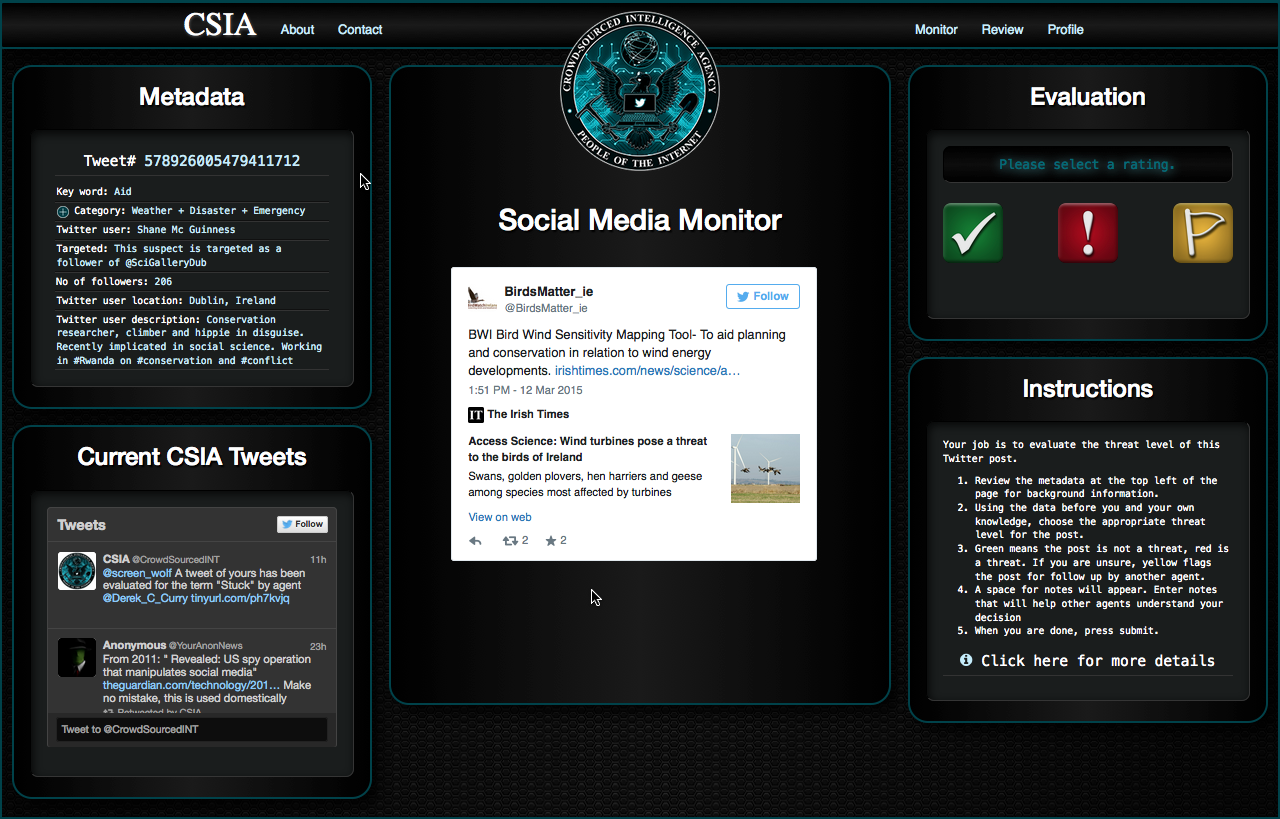
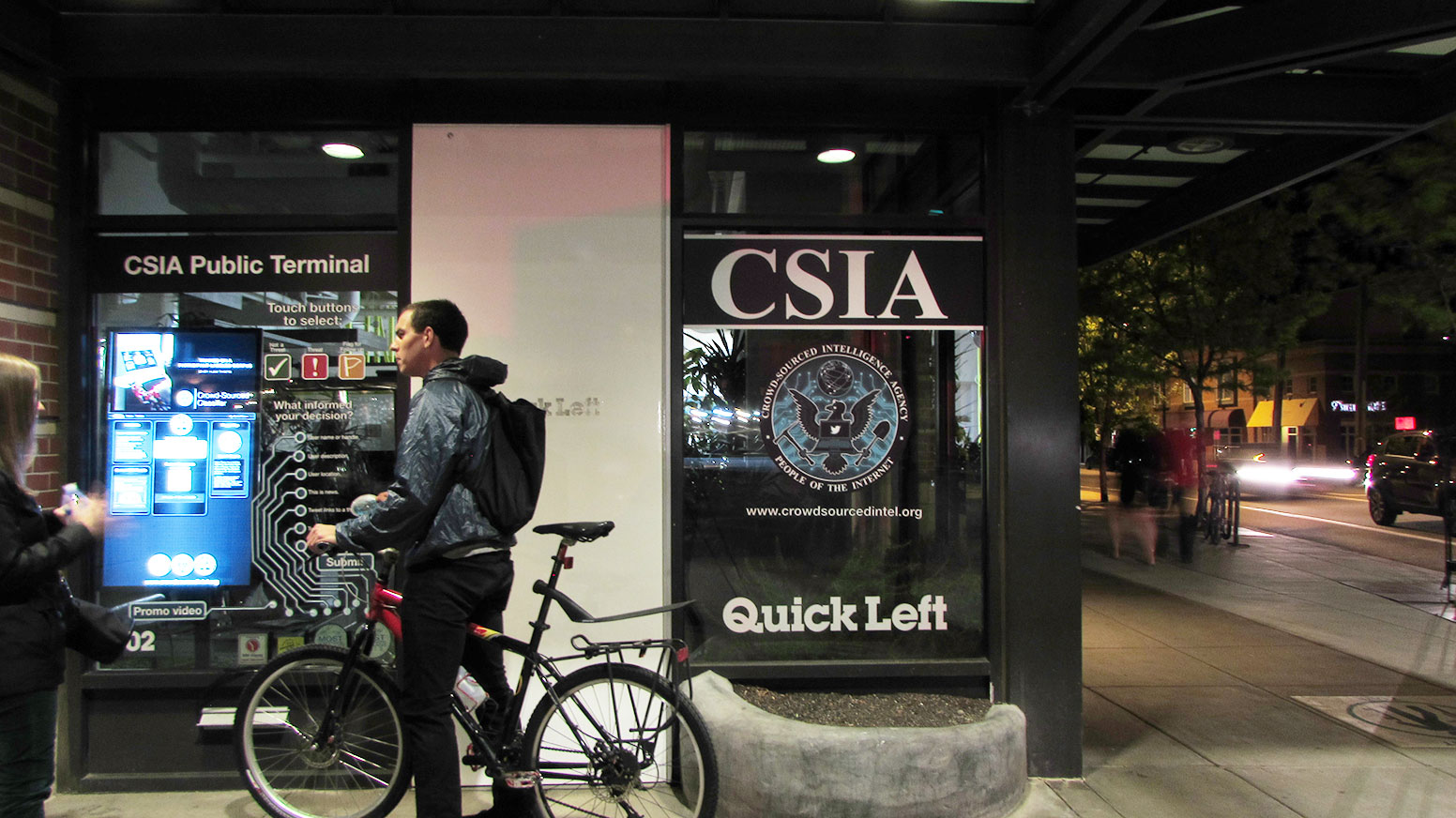
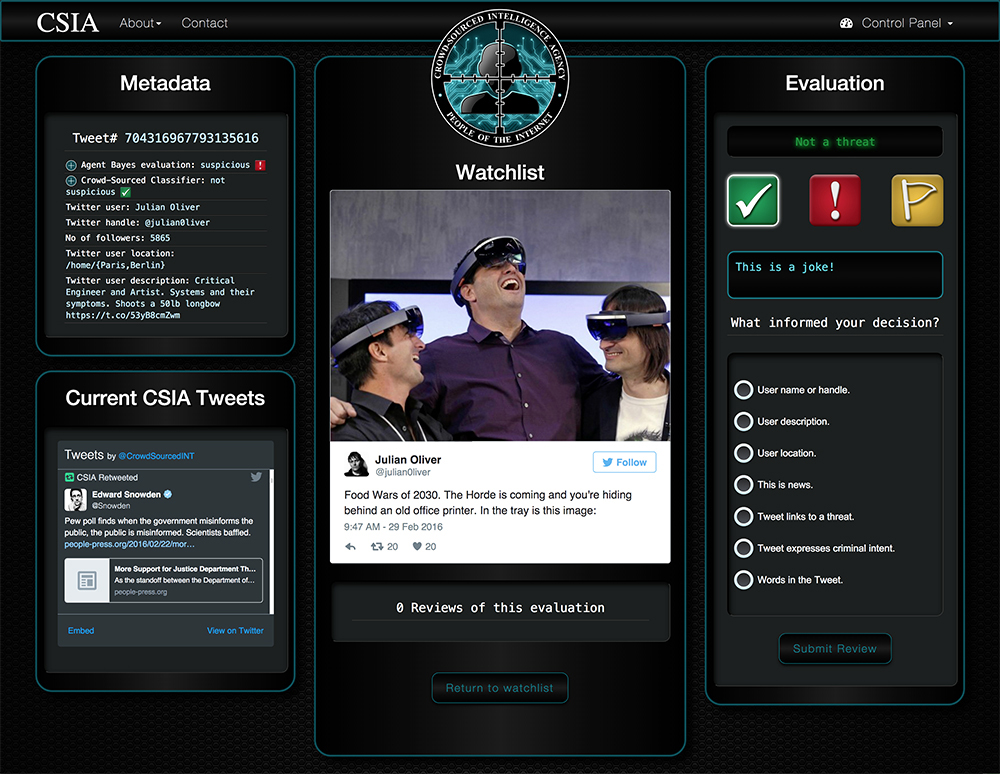
The goal of the CSIA was to expose potential problems, assumptions, or oversights inherent in current dataveillance processes to help people understand both the effectiveness of OSINT processing and its impact on our privacy.
Through practice-based research, we found that the public cannot have meaningful oversight over automated OSINT processing systems unless they can develop technical literacies and have access to the data used to train machine learning algorithms. Through the many exhibitions and presentations of this project, we found it highly impactful for members of the public to see how their own tweets are recontextualized in the interface of an OSINT system, and how this can affect how their posts may be interpreted.
Exhibitions
- The Wrong TV (channel 3), The Wrong Biennale (virtual), 2020
- Input/Output, MCC Art Gallery, Tempe, AZ, 2020
- Self as Actor: Colonizing Identity, NeMe Cultural Center, Limassol, Cyprus, 2019
- Counting Digital Sheep, Tetem, Enschede, Netherlands, 2018
- Nothing to Hide, Brebl / Honing Complex, Nijmegen, Netherlands, 2018
- CRYP2PTO: Imaginarios y máquinas para la autodeterminación, Cultural Center of Spain in Mexico, Mexico City, 2018
- Artificial Intelligence—The Other I, Postcity / Ars Electronica Festival, Linz, Austria, 2017
- Radical Networks 2017, Chemistry Creative, Brooklyn, NY, 2017
- Manifestations 2017, Eindhoven, Netherlands, 2017
- Past and Future Conditions, A1 Art Labs, Knoxville, TN, 2016
- Digital Muddy 2.0, Southern Illinois University, Carbondale, IL, 2016
- Computational Media: New and Old Territories, Sugar City, Buffalo, NY, 2016
- Athens Digital Art Festival 2016: Digital Pop, Athens, Greece, 2016
- MediaLive, Boulder Museum of Contemporary Art, Boulder, CO, 2016
- Interface/Landscape, Finger Lakes Environmental Film Festival, Ithaca, NY, 2016
- SECRET, Science Gallery Dublin, Trinity College, Dublin, Ireland, 2015
- Surveillance, The New Gallery, Calgary, Alberta, Canada, 2015
Citations
- Susan Cahill, States of Observance: Contemporary Art and Surveillance Logic in Canada, 2001–2021, McGill-Queen's University Press (forthcoming, October 2026)
- Imre Dobák and Péter Bérczi, Crowdsourcing: Opportunities and Limitations from a National Security Perspective, 2025
- Dejan Grba, Deep Else: A Critical Framework for AI Art, Digital 2, no. 1: 1-32, 2022
- Dejan Grba, AI Art, Encyclopedia, MDPI, 2022
- Richard Kjellgren, Good Tech, Bad Tech: Policing Sex Trafficking with Big Data, 2022
- Alistair Fraser, Up in the Air: The Challenge of Conceptualizing and Crafting a Post-Carbon Planetary Politics to Confront Climate Change, Journal of Peasant Studies, 2022
- Philip N. Ndubueze, Security Agencies, Open Source Intelligence and Insurgency Control in North East Nigeria, 2021
- Oluwafemi Amos Idowu, Cybercrimes and Challenges of Cyber-Security in Nigeria, 2021
- Louis Everuss, AI, Smart Borders and Migration, 2021
- Karl Van Der Schyff, Kirstin Krauss, and Jan Kroeze, Facebook and Dataveillance: Demonstrating a Multimodal Discourse Analysis, 2018
- Vian Bakir, Martina Feilzer, and Andrew McStay, Introduction to Special Theme Veillance and Transparency: A Critical Examination of Mutual Watching in the Post-Snowden, Big Data Era, Big Data & Society, March 2017
- The Digital Muddy Expanded Media Festival, ArShake: Reinventing Technology, May 25, 2016
- Anthony King, Digital privacy: Subverting surveillance, Nature 524, p. 413, 2015
- 21st Century Digital Art, Crowd-Sourced Intelligence Agency
- docubase, MIT Open Documentary Lab
- Katerina Cizek and William Uricchio, Collective Wisdom: Co-Creating with Communities, Across Disciplines and with Algorithms