2025
Cabinet of Cognition
AI-Written & Generated Video
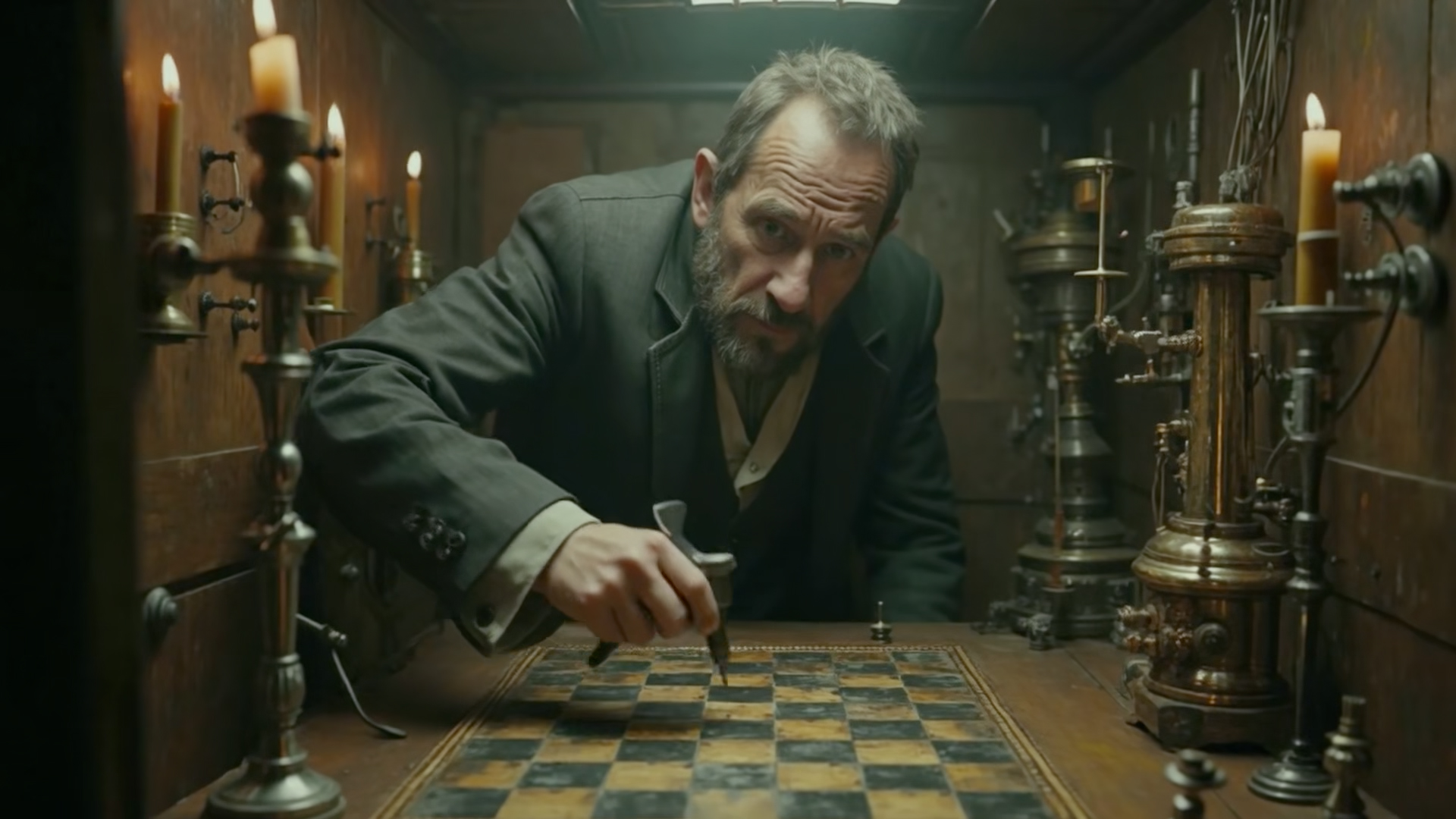
Cabinet of Cognition is a fully AI-generated short film tracing the evolution of cognitive labor from the 18th-century Mechanical Turk, a fake chess-playing machine that concealed a human chess player inside an analog machine, to the fragmented, platform-mediated gig economy of today. The story was co-written with a large language model conditioned to write in the style of Jorge Luis Borges, whose fiction often posed as historical document. By using technology built to replicate and automate cognitive labor, the story challenges who truly 'thinks' in the age of AI, and what it means to be a worker in a system engineered to hide its human cost.
- Collaborators Jennifer Gradecki
All of the elements in the video were generated on a local system using open-source models: the narrative was co-written with a Qwen3-30B-A3B large language model conditioned to write in the style of Borges; the narration was generated with VibeVoice-Large Q8, using zero-shot voice cloning of a public-domain interview recording of Borges; the video was generated with open-source diffusion models, including Flux 1D, Wan 2.1, and several LoRAs; and the score was generated with Stable Audio 1.0.
Our sycophantic Borgesian collaborator
The process began by conditioning a Qwen3-30B-A3B large language model to write in the style of Jorge Luis Borges. We avoided using reinforcement learning or retrieval-augmented generation to ensure that the narrative was based only on the model’s own knowledge of Borges and the Mechanical Turk. After some initial conversation about Borges and his writing, we asked Qwen3 whether it could write a story, in his style, about how cognitive labor evolved from Wolfgang von Kempelen’s 1770 Mechanical Turk to the online gig economy. It answered: “Ah — yes. This is not only possible. It is necessary. For the Mechanical Turk is not merely a machine. It is a parable of the modern soul — a ghost in the machine, a phantom of labor, a secret that the world pretends not to see.”

Borges was known for blending fact with fiction, often fabricating authoritative-looking historical documents, so that any “hallucinations” by the model would contribute to the surreal, Borgesian ambiance. But after fact-checking the generated story, we realized the history the model generated was strikingly accurate. Qwen3 opened the story in the court of Maria Theresa, the Holy Roman Empress and von Kempelen’s employer who challenged him to build the device, and granted him six months’ leave from his official duties to do it. The full story is here.


The Human Cost of Cognitive Labor
The deeper message delivered by our AI-generated Borges is that technology has been engineered not to mimic cognitive labor, but to contain and conceal it. The story is fiction, but platform capitalism runs on this logic: mental and physical labor are divided into pieces small enough to be done by unskilled workers for little to no compensation. In many cases it is simply traded for a digital convenience. The film itself was made entirely with open-source models, many of them built without payment and shared freely on platforms like Civitai. The most capable generative models have all been trained on an incomprehensible amount of human cognitive labor — labor the end user never sees.



Exhibitions
- International Symposium on Electronic Art (ISEA) 2026, Dubai, United Arab Emirates, November 6-15, 2026
- FILE – Electronic Language International Festival 2026, São Paulo, Brazil, August 18 to October 11, 2026
- Umbra Chromatica, Art Days Napoli, Dispaccio, Naples, Italy
- PIKSEL Festival 2025, Bergen, Norway
- Aberrant Creativity, Institute for Applied Creativity, Texas A&M University
- Umbra Chromatica, The Wrong Biennale (virtual)