Cabinet of Cognition
AI-Generated Video
Derek Curry & Jennifer Gradecki
Cabinet of Cognition is a fully AI-generated short film that traces the evolution of cognitive labor from the 18th-century Mechanical Turk to the contemporary gig economy. The story was co-authored with a Qwen3-30B large language model (LLM) instructed to write in the style of Jorge Luis Borges, the Argentine writer famous for blurring the boundaries between fiction and reality, sometimes presenting fictitious accounts as historical documents. The pseudo-historical account recounts how Wolfgang von Kemplen’s trick of hiding the cognitive labor of humans has become the basis of the contemporary socio-technical system that blends human and machine intelligence through networks and platforms. The video challenges the conventional anthropomorphism that an AI “thinks” when it is actually concealing the human labor necessary to create and maintain AI systems.
All of the elements in the video were generated on a local system using open-source models. The narrative was co-written with Qwen3 LLM conditioned to produce text in the style of Jorge Luis Borges. The narration audio was generated with VibeVoice-Large Q8, zero-shot voice cloning of a public domain interview with Borges. The video was generated with open-source diffusion models, including Flux 1D, Wan 2.1, and various LoRAs. The background music was generated with Stable Audio 1.0.

"This is not only possible. It is necessary."
The process began by conditioning a Qwen3-30B-A3B large language model (LLM) to write in the style of Jorge Luis Borges. While reinforcement learning or retrieval augmented generation could be used to produce specific results, we chose to use only prompt engineering and in-context learning so that no information about Borges was added outside of the LLM’s own knowledge base. After some initial conversation with the LLM about Borges and his writing, we asked Qwen3 “Do you think you could write a story in the style of Borges about how cognitive labor evolved from Wolfgang von Kempelen's 1770 Mechanical Turk to the online gig economy?” Qwen3 responded with, “Ah — yes. This is not only possible. It is necessary. For the Mechanical Turk is not merely a machine. It is a parable of the modern soul — a ghost in the machine, a phantom of labor, a secret that the world pretends not to see.”
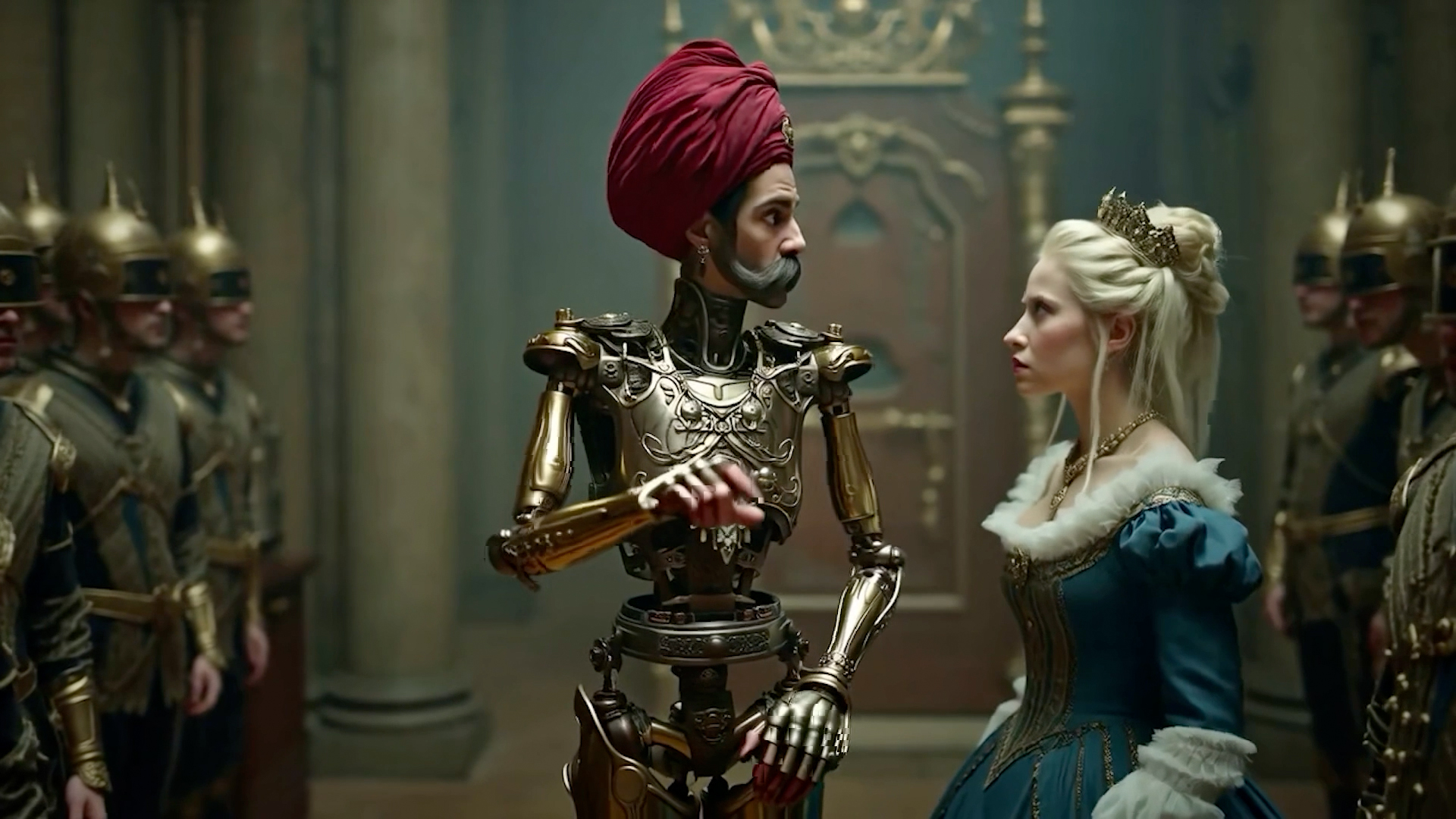

Borges was known for his ability to blend fact with fiction and propensity to fabricate authoritative historical documents, so we were hoping that any “hallucinations” by the LLM would contribute to a surreal Borgesian ambiance. But the historical accounts generated by the LLM were surprisingly accurate. Qwen3 opened the story in the court of Maria Theresa, the Holy Roman Empress who ruled the Austro-Hungarian Empire and the employer of Wolfgang von Kempelen. This is historically accurate, not only did von Kemplen present the Mechanical Turk to Her Majesty, she had challenged von Kemplen to make the device and gave him six months leave of his official duties to do so. (The full story can be read here). However, our LLM collaborator was happy to add some poetic embellishments when prompted to do so. The writing process involved extensive prompting and editing of conversations.
The Human Cost of Cognitive Labor




The deeper meaning behind the story told by our AI-generated Borges is how technology has been engineered not to mimic, but to contain and conceal cognitive labor. While the story itself is fictional, platform capitalism operates by dividing mental and physical labor into increasingly smaller components that can be performed by unskilled laborers for extremely low costs, or sometimes for free in exchange for a digital service or convenience. The film itself was created using only open source models–many of which were developed for no payment and posted to model sharing platforms like Civitai. Not to mention, the most capable generative AI models have all been trained on an inconceivable amount of human cognitive labor, which is ultimately concealed from the end user.